)
An exclusive Q&A with Murray Thom, Vice President of Quantum Technology Evangelism at D-Wave
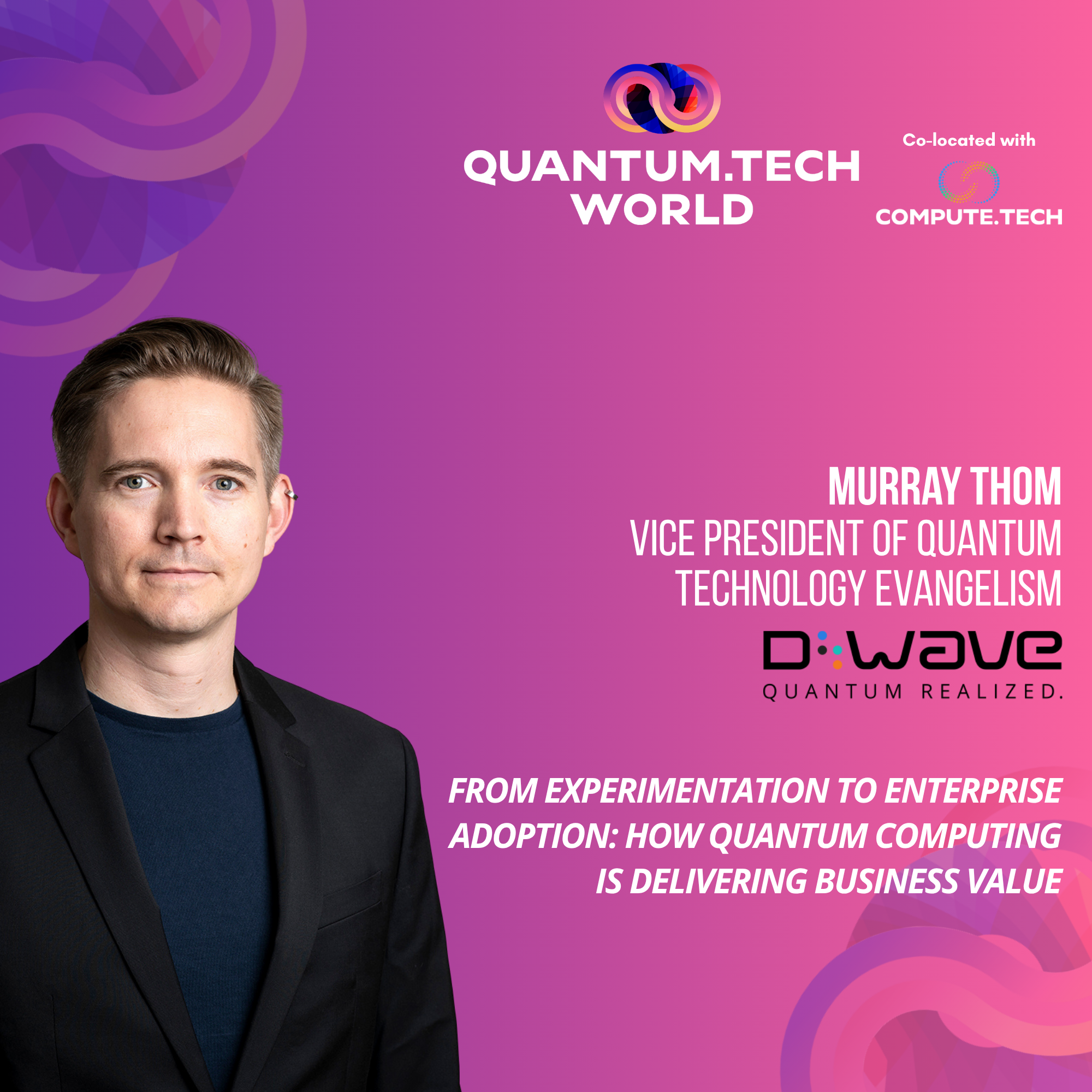
From Experimentation to Enterprise Adoption: How Quantum Computing Is Delivering Business Value
Quantum computing is moving beyond experimentation, with organizations beginning to integrate quantum applications into real business operations. From manufacturing optimization and telecommunications to hybrid computing infrastructure, the conversation is increasingly focused on practical implementation and measurable results.
But what is driving enterprise adoption, where are organizations already seeing value, and what developments could shape the industry in 2027?
We spoke with Murray Thom, Vice President of Quantum Technology Evangelism at D-Wave, to explore the applications gaining traction, the challenges businesses face when moving into production, and the role quantum processors could play alongside classical computing infrastructure.
1. There’s been a lot of discussion about when quantum computing will deliver real commercial value. Where are you already seeing organizations move from experimentation toward practical deployment today?
I think the short answer to this question is “everywhere.” At D-Wave, we’re working with one of the world’s largest airlines, chemical companies, mobile carriers, and healthcare companies. Working with enterprise customers, we are often asked: “How quickly can we implement our first quantum applications?” The fact that several hybrid-quantum applications are already running in business workflows helps move customer conversations from initial discovery to practical implementation.
For example, NTT DOCOMO recently put its second hybrid-quantum application into production, reducing location registration signals by 65.3% at the daily peak and paging signals by 7%, lowering network signalling load and improving operational efficiency. Having learned the business value they can create with quantum computing technology with their first application, DOCOMO has been able to use their expertise to expand into new business use cases.
It is important to note that not all quantum computers are at the same stage of development. Annealing quantum computers are highly performant, reliable and being used by customers to run business operations today. These systems are uniquely well suited to addressing computationally complex optimization problems. Gate-model quantum computers are at an earlier technology readiness level and are helping organizations with quantum computing research and explorations in quantum chemistry.
D-Wave is taking a dual-platform approach to quantum computing, offering products and services spanning both annealing and gate-model quantum computers. We believe that customers will need both annealing and gate-model systems to see acceleration in the full range of computationally complex problems suited to quantum computing. This allows us to begin conversations around business pain points and then only bring forward the technology that is well suited to address them.
2. Optimization is one of the areas where annealing quantum computing is being applied to real-world business problems. Which use cases are gaining the most traction, and what is driving that demand?
We’re seeing strong traction across a variety of optimization use cases, including production scheduling, logistics and routing, workforce scheduling, supply chain coordination, and telecommunications network optimization. The common thread in these use cases is complexity. These problems involve a vast number of interdependent decisions and constraints, and as they grow, classical-only methods can struggle to deliver high-quality solutions at the speed their operations demand.
Manufacturing is a great example. BASF worked with D-Wave on a joint proof-of-concept project that used a hybrid-quantum application to optimize manufacturing workflows in a BASF liquid-filling facility. The hybrid-quantum technology set a new benchmark for manufacturing efficiency, allowing the reduction of production scheduling time from 10 hours to just seconds. The hybrid-quantum application outperformed an existing optimization solution across key operational metrics, reducing lateness by 14%, reducing setup times by 9%, and shortening tank unloading durations by up to 18%.
Businesses are looking for better ways to solve operational problems where complexity limits their ability to make fast, effective decisions. Annealing quantum computing is gaining traction because it is particularly well suited to these hard optimization problems, it is easy to integrate, and well-chosen use cases can deliver measurable business impact today.
3. As enterprises build increasingly heterogeneous computing environments, how do you see quantum processors fitting alongside CPUs, GPUs and HPC infrastructure?
The next era of computing will not be defined by a single architecture. It will be defined by how intelligently we orchestrate different technologies. CPUs, GPUs, QPUs (quantum processing units) and HPC systems each have distinct strengths, and the goal is to match each part of a workload with the computing resource best suited for the task.
We believe that quantum processors will serve as specialized accelerators within these heterogeneous environments, not replacements for classical systems. The classical infrastructure will continue to orchestrate the broader workflow, while the QPU will address specific computationally difficult problems where it may offer advantages in speed, solution quality or energy efficiency.
We’re already seeing this model take shape at the Jülich Supercomputing Centre in Germany, where D-Wave’s annealing quantum computing technology is being integrated into one of the world’s leading HPC environments. This gives researchers direct access to quantum computing within their existing infrastructure and allows them to explore hybrid workflows that draw on the strengths of both quantum and classical systems.
This approach is becoming increasingly important for AI. As models grow larger and more resource-intensive, scaling GPU infrastructure alone is unlikely to be a sustainable long-term strategy. Quantum processors could complement CPUs and GPUs by addressing specific elements of AI workflows, potentially improving model efficiency and solution quality while reducing overall compute and energy demands.
4. What are the biggest barriers preventing more organizations from putting quantum applications into production, and what needs to change to accelerate adoption?
Definitely the biggest barrier is awareness. Many people don’t yet know that enterprises have already integrated quantum computers into their business operations. That makes education, awareness, and communication of existing customer successes very important.
Second to awareness would be identifying the right problem. Not every business challenge is the right fit for quantum. Organizations should start with high-value problems where complexity is limiting speed, solution quality or the ability to respond to changing conditions. Strong use cases often involve planning, scheduling or operational execution, where complex decisions must be made in dynamic environments.
Organizations should also look for areas where they have found that classical approaches appear to have reached their limits. Teams may be simplifying models because the full problem is too difficult to solve, evaluating fewer scenarios than they would like or spending significant time manually adjusting solutions as conditions change. Those are signs that complexity has become a business bottleneck.
Finally, the data and business case also need to be ready. Quantum computing cannot compensate for inconsistent data, unclear objectives or poorly defined constraints. This means that accessible data, measurable goals and well-defined constraints provide the foundation organizations need to move an application from evaluation into production.
5. Looking ahead to 2027 and beyond, what developments do you think will have the biggest impact on enterprise adoption of quantum computing?
Quantum computing has reached an important inflection point, shifting from hardware-constrained pacing to software-accelerated progress. As quantum systems become easier to program, more developers can work with them, iteration cycles can shorten and successful applications can spread more quickly across organizations and industries.
At the same time, we’re seeing meaningful hardware progress across both quantum computing platforms. Commercial momentum in annealing quantum computing continues to grow, while we anticipate that gate-model technology development will rapidly advance toward practical, fault-tolerant systems. In August, D-Wave published peer-reviewed results in Nature demonstrating a fast, high-fidelity two-qubit entangling gate that preserves the error-detection advantages of D-Wave’s superconducting dual-rail qubit architecture. The results address one of the industry’s most consequential challenges by reducing the immense quantum and classical hardware overhead typically required to detect and correct quantum errors as systems scale.
Ultimately, enterprise adoption in 2027 will be defined not by qubit counts, but by measurable business results. The clearest sign of progress is when an organization like NTT DOCOMO solves one problem with quantum computing, realizes value and returns with the next challenge. That repeat adoption shows quantum is becoming a strategic computing resource rather than an isolated experiment. The conversation has shifted from “Should we use quantum computing?” to “How quickly can we put it to work?”
Continue the Conversation at Quantum.Tech World 2027
From real-world optimization and hybrid quantum-classical computing to the next generation of enterprise applications, these are among the conversations shaping the future of quantum technology.
Quantum.Tech World 2027 brings together enterprise technology leaders, quantum innovators, researchers, investors, and government representatives to explore the technologies and applications moving the industry forward.
May 25–26, 2027 | Encore Boston Harbor, Boston, USA